Currents
Strategy · Product logic · UX · Design · Development
Designing an account-free reflection app that replaces permanent personality labels with situational guidance.
Visit the live project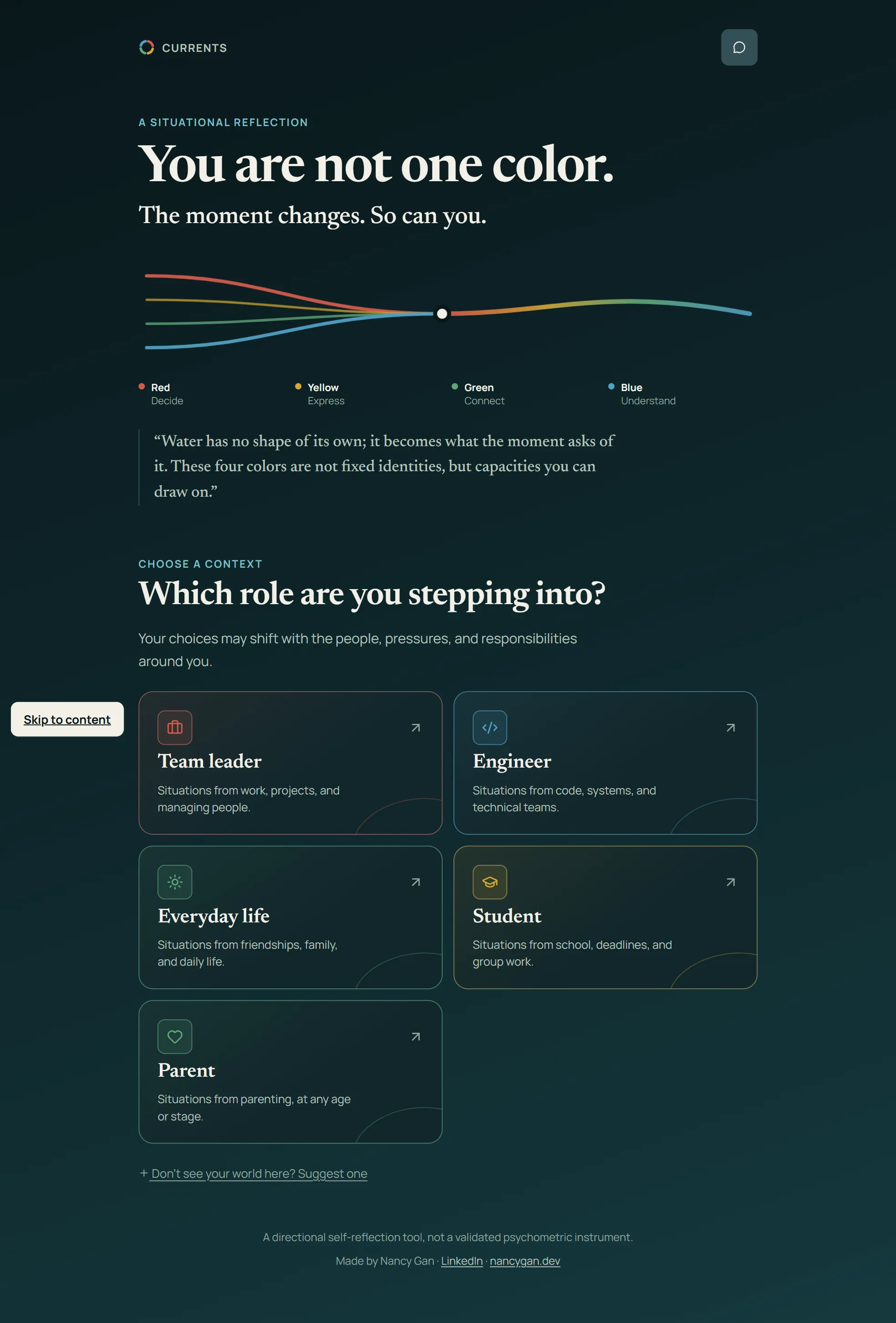
How it started
How can personality discovery guide us without defining who we are?
Currents began with a period of deep self-reflection and a tension within familiar personality systems: they can help people recognize themselves, but their labels can also begin to feel permanent.
Exploring connections between Western color-based personality frameworks and Eastern philosophy opened another possibility. Rather than using color to declare who someone is, color could point toward a quality they may need in a particular moment.
That personal inquiry became a product question with wider relevance: could a reflection tool help people who are struggling to define themselves move toward greater awareness and choice, without replacing uncertainty with another fixed identity? Currents was designed and developed as an answer.
Project outcome
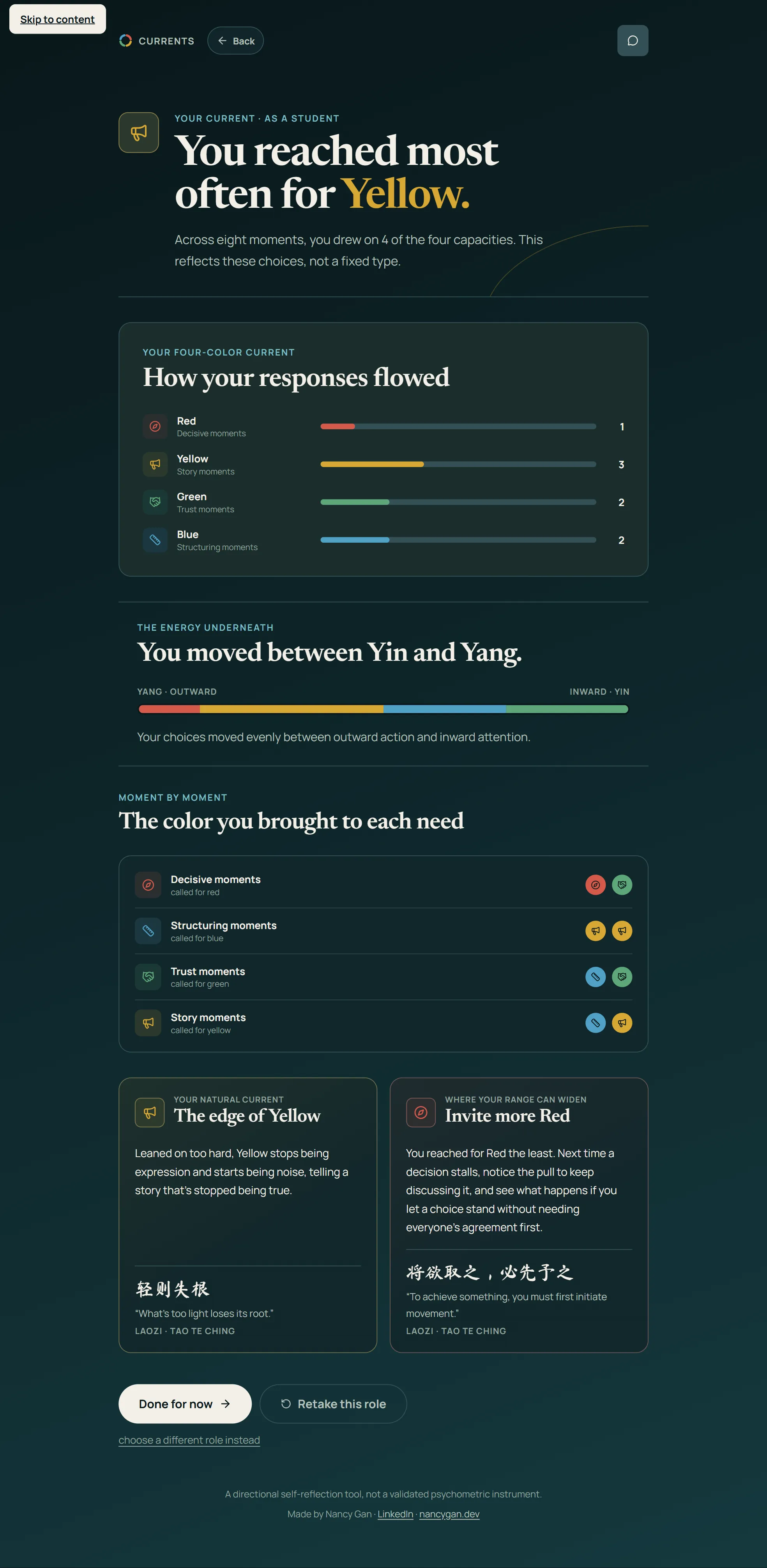
A live, account-free web product with four possible responses, no scores, and no permanent personality type to collect.
Capabilities applied
- Product strategy
- Product logic
- UX design
- Interface design
- Web development
Technologies used
- Lightweight client-side React single-page application
- Vite
- Google Apps Script feedback webhook
- Google Sheets
01
The product problem
A fixed label was the wrong destination.
Most self-reflection tools reduce a person to a score, category, or label meant to explain who they are. That familiar outcome conflicted with the more situational question Currents wanted to ask: what does this particular moment need?
What it enabledThe product needed to support noticing and choice without turning an answer into an identity.
02
The premise
Treat color as a response, not a type.
Currents connects the familiar Western four-color framework with Laozi’s philosophy of water. A color is not presented as a permanent trait. It represents a quality a person may need to bring to a particular situation.
What it enabledThe framework could remain recognizable while serving a fundamentally different purpose.
03
The critical decision
The score had to come out.
Early versions used a scoring system, but a score implied that one response could be more correct than another. That worked against the idea that there is no universally right color—only the response a given moment calls for.
What it enabledRemoving the score aligned the interaction with the product’s underlying philosophy.
04
The interaction
Give the reflection enough context to be useful.
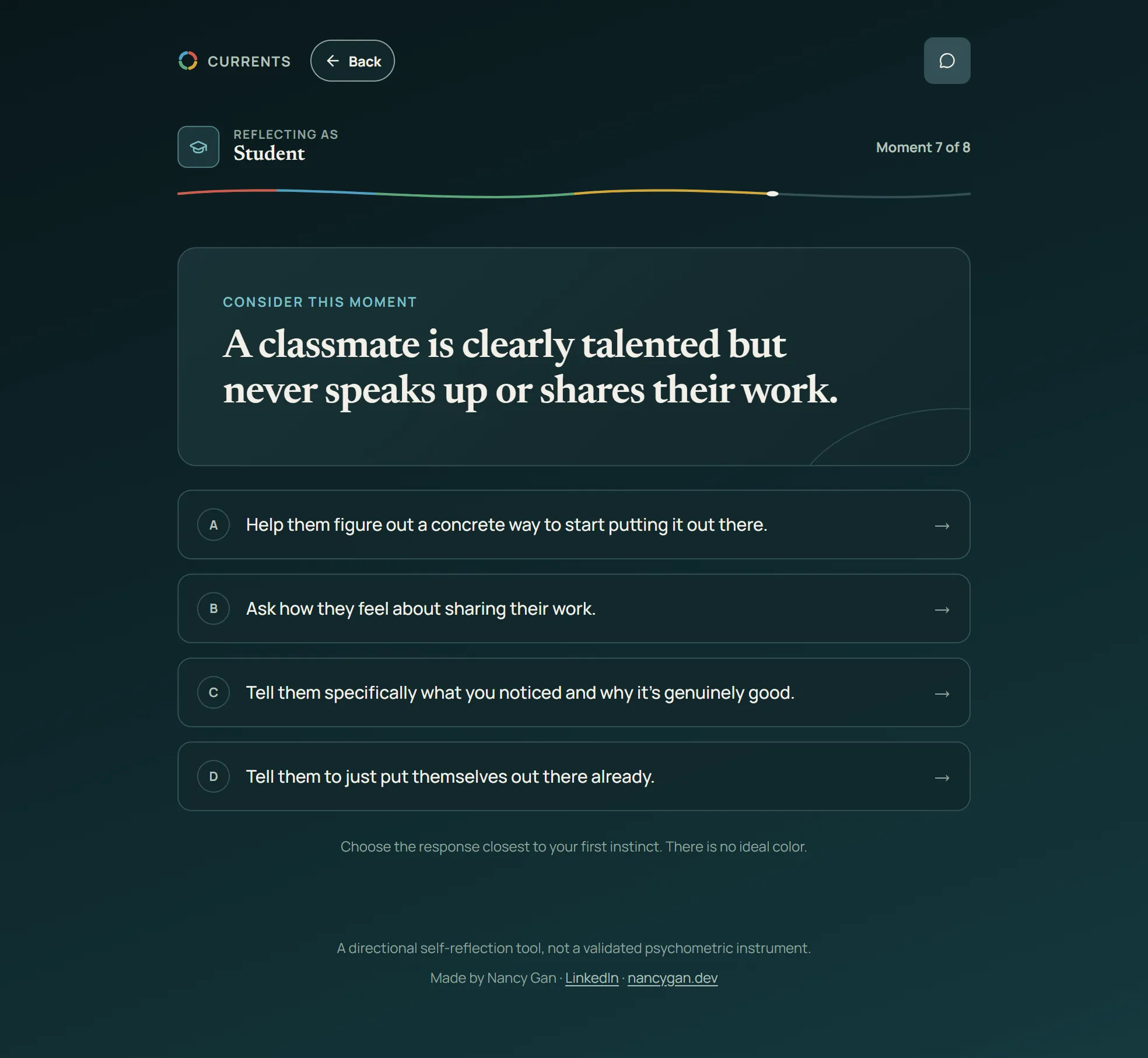
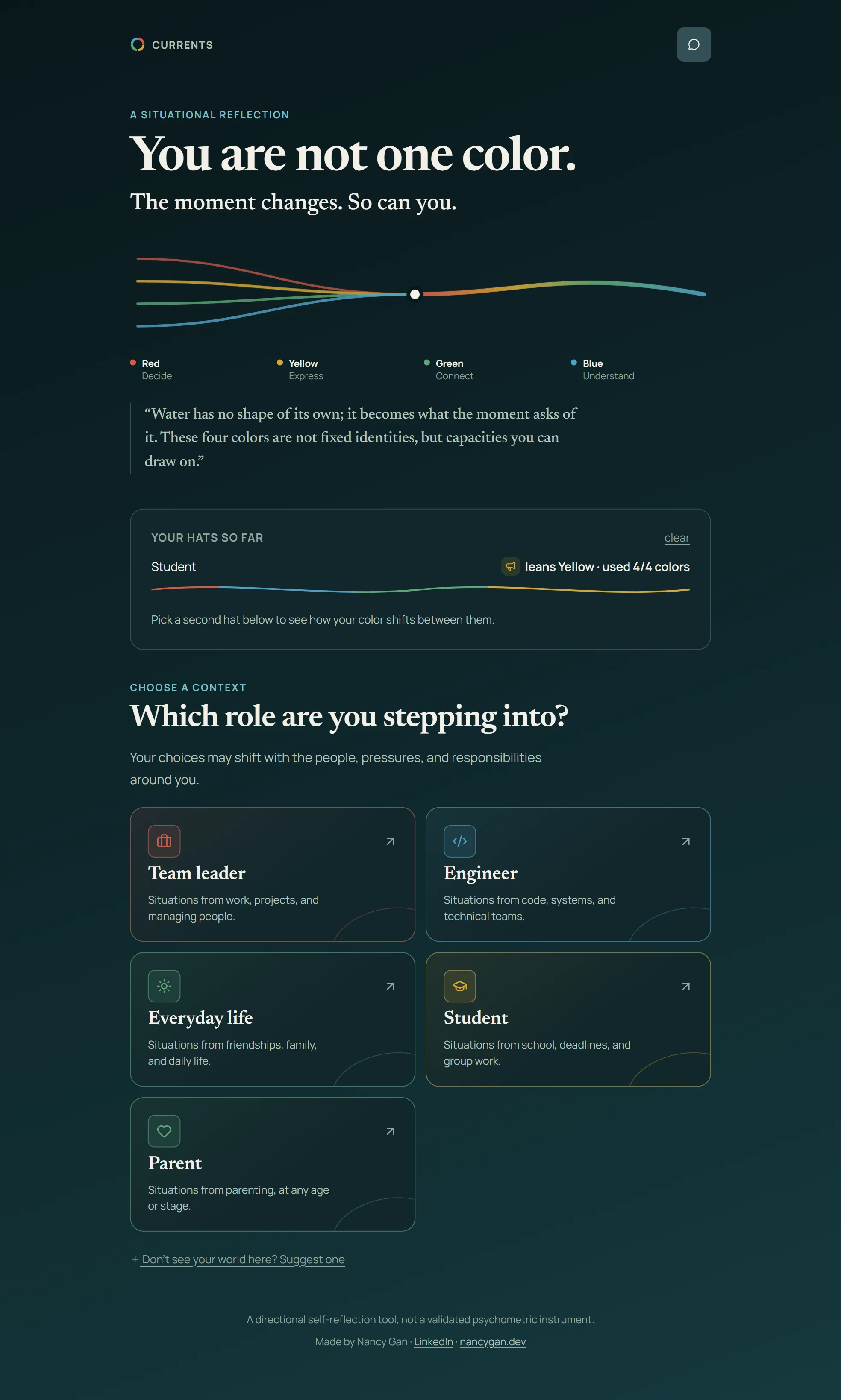
The experience begins with the hats people wear—such as team leader, engineer, student, parent, or everyday life—before asking them to consider a real situation. This grounds the reflection in context rather than abstract self-description.
What it enabledPeople respond to a concrete moment instead of completing a generalized personality assessment.
05
The shipped outcome
A small idea became a complete live product.
Currents is live at its own subdomain with four colors, no scores, and no account requirement. The work carried the original premise through product logic, interface design, development, and launch.
Have a project with a problem worth untangling?
Let’s make the next
useful thing.
No polished brief required. Bring the idea, constraint, or problem as it is.
Start a project Explore design and development services