Veil
Product strategy · Brand · UX · Development
Creating a private wedding website and connected guest experience around access, control, and personal fit.
Landing page (live)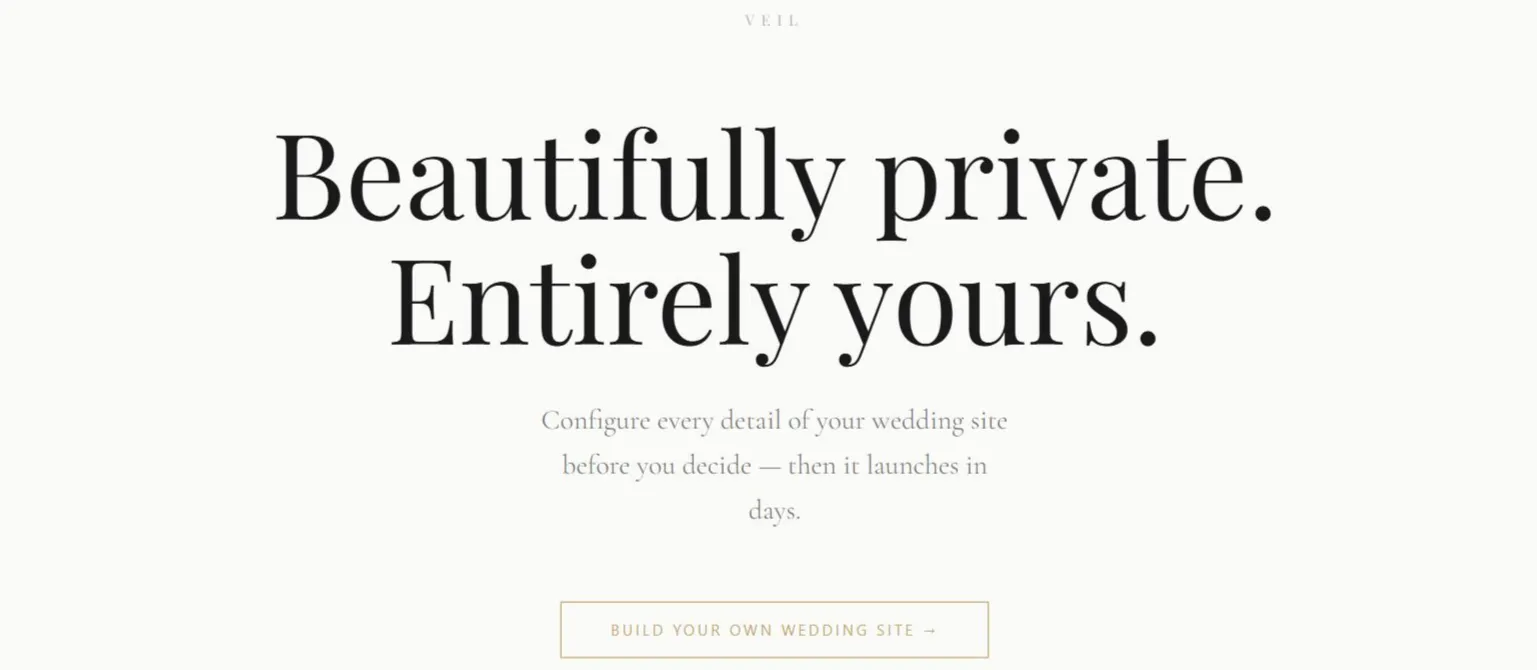
How it started
How can a couple create a memorable wedding experience without giving up privacy or control?
Veil began when a newly engaged couple asked for something mainstream wedding platforms could not comfortably give them: a private digital space they could genuinely control. They were concerned about guest email addresses being used for promotion, wedding details appearing in search results, and unexpected visitors reaching information intended only for invited guests.
They also wanted planning rules to match their wedding. Preset plus-one allowances, a carefully selected registry, guest management, and their own administrative tools all needed to work together without last-minute surprises.
Just as importantly, the experience needed to feel unmistakably theirs: a unique URL, a custom visual identity rather than a standard template, and the flexibility to add event photographs later. The answer was a private, full-stack wedding platform shaped around guest privacy, operational control, and the couple's story.
Project outcome
A finished code-gated wedding website for invited guests, followed by a broader Veil product direction connecting RSVP, registry, guest-management, administrative, and payment needs.
Capabilities applied
- Product strategy
- Brand direction
- UX design
- Interface design
- Full-stack web development
- Backend system development
- Database architecture
- CRM and guest management
- Payment integration
- Registry integration
- Automated transactional email
- Administrative dashboard design
- Data filtering and sorting
- Code-gated access
- Privacy-centered design
01
The starting constraint
Privacy could not be added at the end.
Veil began with a wedding website for a couple who wanted event details kept away from search engines and open public access. Invited guests entered through a code, making privacy part of the experience from the beginning.
What it enabledAccess shaped the information architecture and interaction model instead of becoming a superficial setting.
02
The real scope
The project was larger than a collection of pages.
Behind the private guest experience, the couple needed to manage a guest list, set plus-one limits, and connect RSVPs, registry information, payment needs, and administrative work.
What it enabledThe website had to function as both a personal event experience and an operational system.
03
The product decision
Fit the system to the event.
The couple did not want to reshape their wedding around the defaults of a generic public platform. Guest rules, access, content, and planning requirements needed to reflect how their particular event would work.
What it enabledThe design connected public storytelling, private guest needs, and administrative control around one event-specific model.
04
The full-stack system
Connect the experience to the operations behind it.
Veil extended beyond the public-facing website into a backend database, guest and CRM management, payment and registry integrations, automated transactional email, administrative controls, and tools for filtering and sorting information.
What it enabledThe guest experience and the couple’s operational work could function as parts of one connected product.
05
The outcome
A private build revealed a broader product opportunity.
The finished private site was warmly received by the guests who used it. The project also showed that other couples may want the same emphasis on privacy, control, and personal fit.
What it enabledThat learning became the foundation for Veil’s gated, self-serve product direction, which remains in progress.
Have a project with a problem worth untangling?
Let’s make the next
useful thing.
No polished brief required. Bring the idea, constraint, or problem as it is.
Start a project Explore digital experience capabilities