01
Guide different customers
Create clear paths for audiences with different needs, priorities, locations, or levels of readiness.
So each customer reaches the right next step sooner.
Digital experience design · H-A-T
Your business has its own story, customers, and way of working. Your website should be designed around them—not squeezed into a layout made for everyone.
H-A-T creates digital experiences for organizations that need clearer positioning, purposeful content, and an experience that helps people take the next step.
When the website no longer fits
A website does not have to be visibly broken to hold a business back. Sometimes it simply no longer explains the company clearly, supports the customer journey, or reflects the level of work happening behind it.
The colors and images may be different, but the structure feels like every competitor’s website. Visitors see a category before they see your particular value.
New services and ideas have been added over time, but customers are left to work out what matters and where to begin.
The website asks people to contact you without preparing them, qualifying their needs, or collecting the information your team actually uses.
Important explanations happen repeatedly through email, phone calls, and manual follow-up because the website does not carry enough of the conversation.
Your business may need a thoughtful application, booking, payment, or private customer journey—but the current site can only send everyone to the same generic form.
The company has matured, but the website still represents an earlier version of its positioning, confidence, or ambition.
What an ill-fitting experience costs
Customers rarely announce that a website confused them. They hesitate, leave, submit an incomplete inquiry, or choose a competitor who made the decision feel easier.
Behind the scenes, your team compensates—explaining the same details, sorting poor-fit leads, connecting disconnected tools, and finding manual ways around what the website cannot do.
The uncertainty disappears with the visitor. The consequences stay with the business.
Better design is not simply a better-looking surface. It removes uncertainty for customers and unnecessary work for the people serving them.
What “custom” should mean
Digital experience work begins before colors, typography, or animation. It begins by understanding what people need to understand, trust, and accomplish.
What should a visitor understand within the first few moments? What makes the offer credible? Which customers need different paths? What uncertainty prevents them from acting? What information would make the first conversation more productive?
The design grows from those answers. The result is not different merely for the sake of looking different. It is different because the business, audience, and purpose are different.
Each decision gives the next one somewhere stronger to stand.
One connected process
You work directly with the person making the strategic, creative, and production decisions. Context does not have to travel through layers before it reaches the work.
We identify what you offer, who it is for, why it matters, and what customers need to believe before they act.
I help organize the information, develop the page structure, and write or refine the copy so the website communicates with purpose.
The visual system and customer journey are created around the content—not the other way around—so the finished website feels distinctive, coherent, and easy to use.
Designed around the moments that matter
The right experience depends on what customers need and what the business should no longer have to handle manually.
Create clear paths for audiences with different needs, priorities, locations, or levels of readiness.
So each customer reaches the right next step sooner.
Ask useful questions, establish expectations, and help prospects reach the right service before your first conversation.
So the first conversation begins with useful context.
Bring applications, bookings, payments, registrations, or other important steps into a cohesive customer journey.
So interest can become action without a disconnected handoff.
Control who can reach sensitive or invitation-only content when public access is not appropriate.
So sensitive information reaches only the intended people.
Break down detailed services, processes, and decisions without overwhelming the person trying to evaluate them.
So customers can make a confident decision.
Establish a flexible visual and content foundation that can support new services and ideas without losing coherence.
So growth does not mean starting the website over.
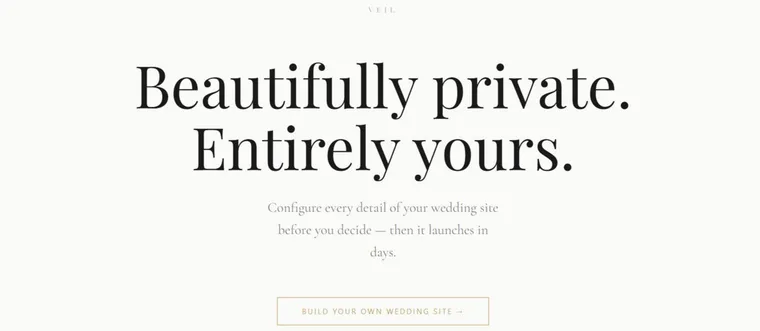
The public Veil concept. The original wedding experience remains private by design.
Custom thinking in practice · Veil
A couple needed a wedding website that only invited guests could access. Search engines could not index it, and people without the code could not enter. Privacy was not a setting to consider later—it shaped the experience from the beginning.
Behind the guest-facing site, the couple could manage their guest list and event-specific decisions. RSVP rules, plus-one limits, registry, booking, and administrative needs were considered as parts of one experience instead of isolated additions.
The private site launched successfully and was warmly received by the guests who used it. Nancy then used what she learned to create Veil: a concept for future couples who may want the same privacy, control, and personal fit.
What stays unseen matters. The original wedding URL, guest records, access code, and private administrative screens are intentionally not published as portfolio material.
Read the Veil case studyFrom uncertainty to launch
A rough explanation of the business, the current friction, and the desired change is enough to begin.
We begin with the business: what has changed, what customers need, what feels limiting today, and what the new website should make possible.
I organize the priorities, audiences, content, functionality, and customer journeys into a clear direction.
The page structure, copy, visual language, and interactions are designed as one connected experience.
You review meaningful progress at agreed checkpoints while I turn the direction into a working website and test it across relevant screens.
The final experience is reviewed, prepared, and launched with a clear understanding of what was created and how it will be managed.
Bespoke project proposals
No two custom websites carry exactly the same responsibilities. The right scope depends on the message, customer journeys, content, functionality, integrations, visual assets, existing systems, and delivery needs involved.
After an initial conversation, you receive a bespoke proposal defining the recommended work, deliverables, schedule, and project investment. You can review the complete recommendation before deciding whether to move forward.
The goal is a responsible scope built around the outcome—not a generic package organized around page count.
Request a project proposalWhat the work can include
Before we begin
The proposal makes the particular scope clear. These answers cover the questions that usually come first.
Each custom website is scoped around what the business and its customers need the website to accomplish. After an initial conversation, you receive a bespoke proposal outlining the recommended work, deliverables, schedule, and project investment before deciding whether to proceed.
A custom website is planned and designed around a specific business, audience, message, and set of customer actions. It is not simply an existing layout restyled with different colors and copy.
Yes. Content strategy, page organization, and copywriting can be developed as part of the engagement. Design decisions are stronger when the message and customer journey are considered from the beginning.
Yes. A redesign is appropriate when the current website’s positioning, structure, content, or overall experience no longer supports the business. Useful existing material can be evaluated and carried forward rather than automatically discarded.
Timing depends on the scope, content readiness, functionality, feedback schedule, and launch requirements. The proposed schedule is defined before the project begins.
Your knowledge of the business is essential, especially during discovery and key review points. I organize that input into clear decisions so you do not have to direct every detail of the website yourself.
That requirement is discussed during scoping. The editing experience should reflect what your team realistically needs to change and how often, rather than adding complexity nobody will use.
Yes, when those capabilities support the customer journey. Their requirements are defined during scoping because a simple connection and a deeply tailored workflow involve different levels of work.
Yes. H-A-T works remotely with organizations wherever the project, access, and collaboration requirements can be handled effectively.
New requirements are discussed before additional work begins. Their effect on price and timing is documented so both sides understand the change.
Start with what you know
You do not need a finished sitemap, polished copy, or technical specification. Tell me about the business, what the current experience is missing, and what you want customers to understand or do.
Discuss the experience Existing website fundamentally right, but not working correctly? Explore repair + updates.